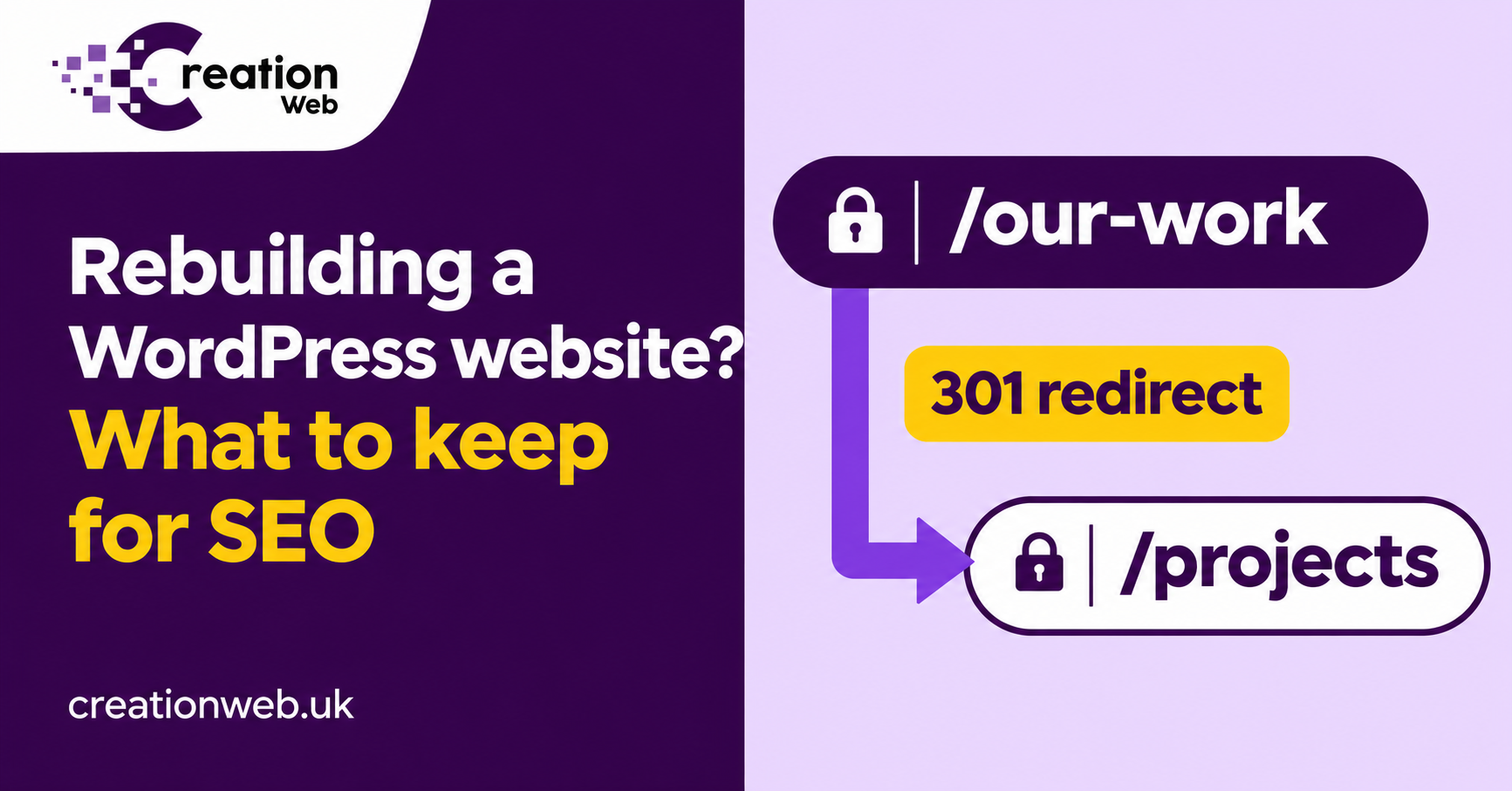
Rebuilding a WordPress website? What to keep for SEO
Before approving a new design, find out which old pages bring customers to your door. Here’s what to keep, what to redirect and what to test on launch day.

Don't have an account? Create Account
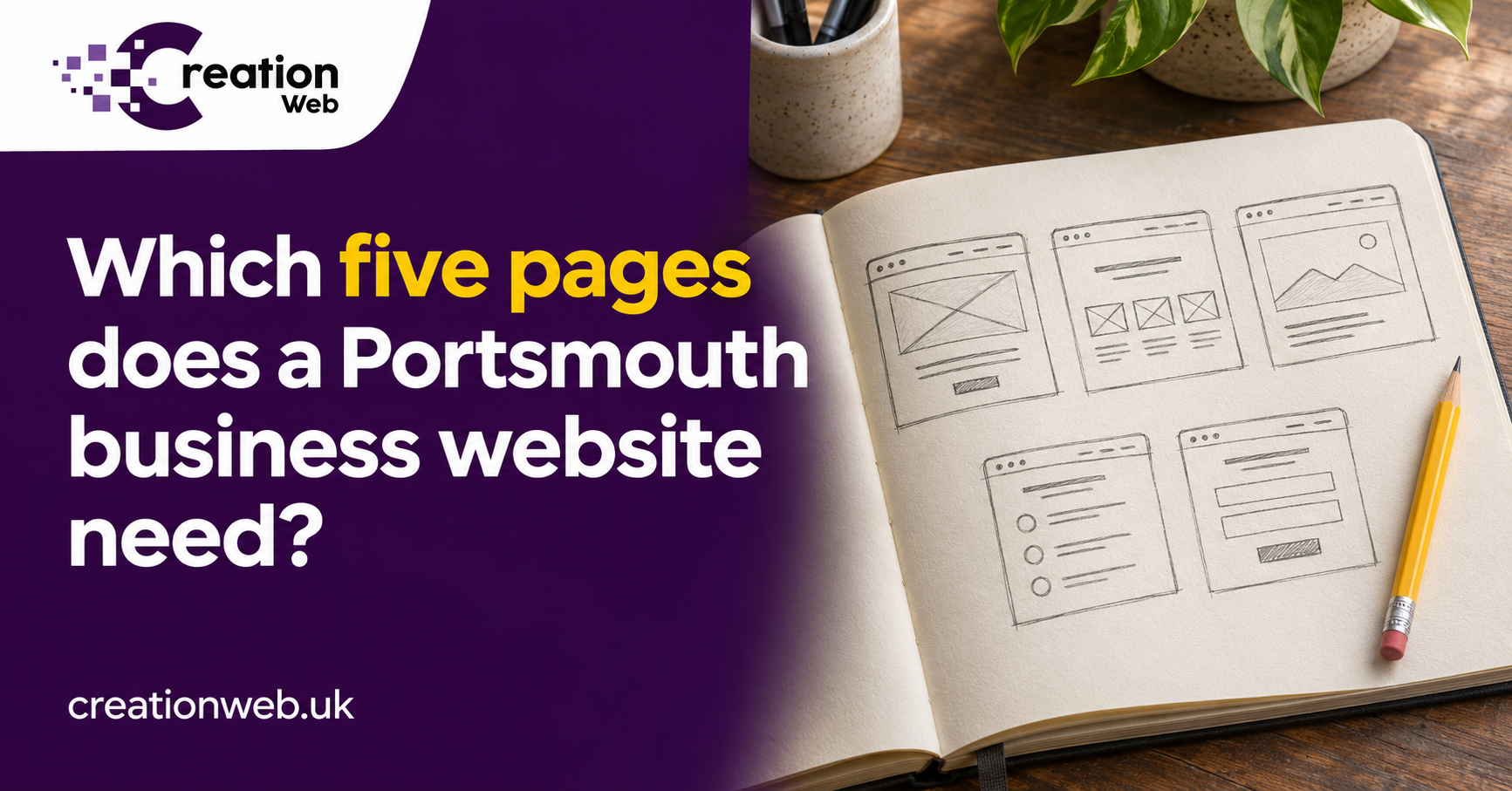
A carpenter, a caterer and a training provider can all start with five pages. The difference is what their customers need to see before they’ll get in touch.
Team Creation
Author
For a Portsmouth business that wins work through enquiries, I’d start with Home, Services, Our Work, About and Contact. Before committing to those five, write down the last three questions somebody asked before hiring you. If one was “Can I see a sample menu?” or “When’s the next course?”, that answer deserves space in the main navigation.
Before you name a single page, open your sent emails. Look for a job you’d take again tomorrow and a job you knew immediately you’d have to turn down. What did those customers ask for? What did you need to know before giving them an answer? For a kitchen fitter, that might be whether the customer already has units on order. For a payroll company, it might be how many employees they pay and whether they’re moving from another provider.
Those details tell you what belongs on the website. If every decent enquiry starts with a conversation about a site visit, explain the visit and give it a button of its own. If half your enquiries fall outside the area you cover, put your service area where people choose the service. Leaving it until the contact form means they’ve already spent time planning a job you can’t take.
Think about how people arrive, too. A recommendation in a local Facebook group might send somebody straight to a project. A search for a fitted wardrobe might take them straight to Services. Both pages need to make sense to a reader who has never seen the homepage.
Imagine someone opens your site on their phone after a neighbour recommends you. They know your name, but little else. The first screen should tell them what you do, where you work and how to enquire. “Fitted wardrobes and alcove shelving in Portsmouth” gives them something to act on. “Quality solutions for your home” leaves them guessing.
A photograph of a finished job does more here than a stock picture of a toolbox. Put a brief caption underneath so people know what they’re looking at. If you cover Southsea and Cosham but travel further for larger jobs, say so once, in ordinary English.
For a local service business, I’d give the first screen one recognisable image, a headline that names the work and a clear next step. If customers usually need a home visit, “Arrange a measuring visit” is more helpful than “Discover more”. Use the following part of the page to answer the first objection you hear on the phone. That might be whether you take on small jobs or whether customers can supply their own materials.
There’s a practical way to test the draft. Open it on your phone, show it to somebody unfamiliar with the business for a few seconds, then take the phone away. Ask what you sell, who you serve and what they’d tap next. If they remember the photograph but can’t tell you what the company does, the opening needs another pass.
Use the words customers use on the phone. For a fitted wardrobe, they may want to know whether you work around sloping ceilings, whether painting is included and whether a home visit comes before the quote. Three short answers can save both of you a wasted call.
Our GE Carpentry website project is a local example. The Portsmouth firm handles storage, decking, kitchens and other carpentry. If your own range is that broad, group the work by what someone wants done. You can give a service its own page later when you have enough examples and questions to justify it.
Write the headings before the paragraphs. If your services share the same customer, buying process and next step, a single well-organised page can work. A decorator offering interiors, exteriors and wallpapering could show each service with its own photograph, explain the preparation involved and invite the customer to arrange an estimate.
Separate pages become worthwhile when the questions change. A Portsmouth cleaning business might sell weekly domestic cleaning to households and end-of-tenancy cleans to landlords. The second customer may need a fixed date, an inventory checklist and an invoice for an agent. Packing those details into a generic cleaning page makes the service harder to buy. If those bookings matter more than a photo gallery, spend the fifth page on end-of-tenancy cleaning and put examples on the relevant services instead.
Pick two or three jobs you’d happily do again. For each one, show the starting point, what the customer asked for and the finished result. A caption such as “We fitted storage around the chimney breast so the customer could keep their existing fireplace” explains a decision that a photo alone can’t.
For a business without visible before-and-after results, this page can earn its place another way. A training provider might use it for course dates. A caterer might publish menus and minimum booking numbers. Give that page the name customers will recognise.
Say who answers the enquiry, who carries out the work and what experience is relevant. If the owner measures up and fits the wardrobes, that’s worth telling people. A real team photo and a short explanation of how visits work will usually answer more questions than a long company history.
Ask for the details you use to decide the next step. For a local trade that might be a postcode, a short description and an optional photo. Give people a working phone number as well. Before launch, send an enquiry from your own phone and check it reaches the person who prepares estimates.
A trade that wins work by recommendation could use Home, Fitted Furniture, Other Carpentry, Recent Jobs and Contact. A short introduction to the carpenter can live on Home. Someone looking for fitted furniture then has one page they can bookmark, send to a partner and return to before requesting a visit.
An event caterer could use Home, Menus, Weddings, Private Events and Enquire. Menu choices, minimum numbers and how far the team travels all affect the buying decision. An enquiry form can ask for the venue, date and rough headcount. Someone with an August wedding shouldn’t have to write a long message just to find out whether you cover the venue.
A training provider might choose Home, Courses, Group Training, About the Trainers and Booking. An employer arranging training for twelve staff has different questions from someone booking one place. Giving the employer a page that explains venue requirements, group size and how to ask about dates can save a lengthy email exchange.
Ask the designer to write the five page names into the proposal and state who is supplying the words and photographs. “Five pages” could mean five finished pages with copy written from an interview, or five layouts waiting for you to fill them. Ask what happens if your service list needs another page, who sets up the form and whether you’ll be able to change a price or swap a photograph yourself.
Agree what counts towards the allowance. A privacy notice, booking confirmation or thank-you page can sit outside the main navigation and still require work. If a booking tool takes customers elsewhere, ask who sets it up and how you’ll know a booking came from your website. These details explain why two quotes for the same number of pages can cover quite different jobs.
For the handover, try one realistic journey on a phone. Start on an individual service page, find a relevant example, return to the service and send an enquiry. Check that a customer can tap the phone number, read the form labels and recover if they miss a required field. Then read the email that lands in the office. If it contains everything you need to make the first call, the pages are doing their job.
At Creation Web, we plan business website designs around the enquiries a company wants to receive. If you’re comparing the cost of a five-page website, send us your proposed page list and one recent enquiry you’d like more of. That gives us a much better starting point for a quote.
If this is close to a project you are planning, tell us what you need and we will quote it.
Before approving a new design, find out which old pages bring customers to your door. Here’s what to keep, what to redirect and what to test on launch day.
We're here to help with your next project
Send your message any time you want.
WhatsApp us!